Starting out in the US
How to start a florist business in the USA: the 2026 guide to licenses, taxes, certifications and your first customers
Short answer
To start a florist business in the USA, begin as a sole proprietor or a single-member LLC, get a free EIN from the IRS, register for a seller’s permit so you can collect sales tax and buy wholesale with a resale certificate, and check your city or county for a business license. No state requires a florist license; Louisiana asks for a floral dealer permit. Set aside money for 15.3% self-employment tax and quarterly estimated payments, then launch with a small menu of signature designs photographed well.
In this guide Jump to what you need
Starting a flower shop in the US is easier than most people think: no state requires a florist license, and Louisiana only asks for a simple floral dealer permit with no exam. What you do need is the right paperwork for taxes, a way to buy at wholesale prices, prices that actually pay you, and photos that make people want to order. This guide covers all of it in plain English, from the EIN to your first Mother’s Day. For the photos, FlowerShoot, a flower photography app for florists, turns a phone photo of your work into a studio product photo.
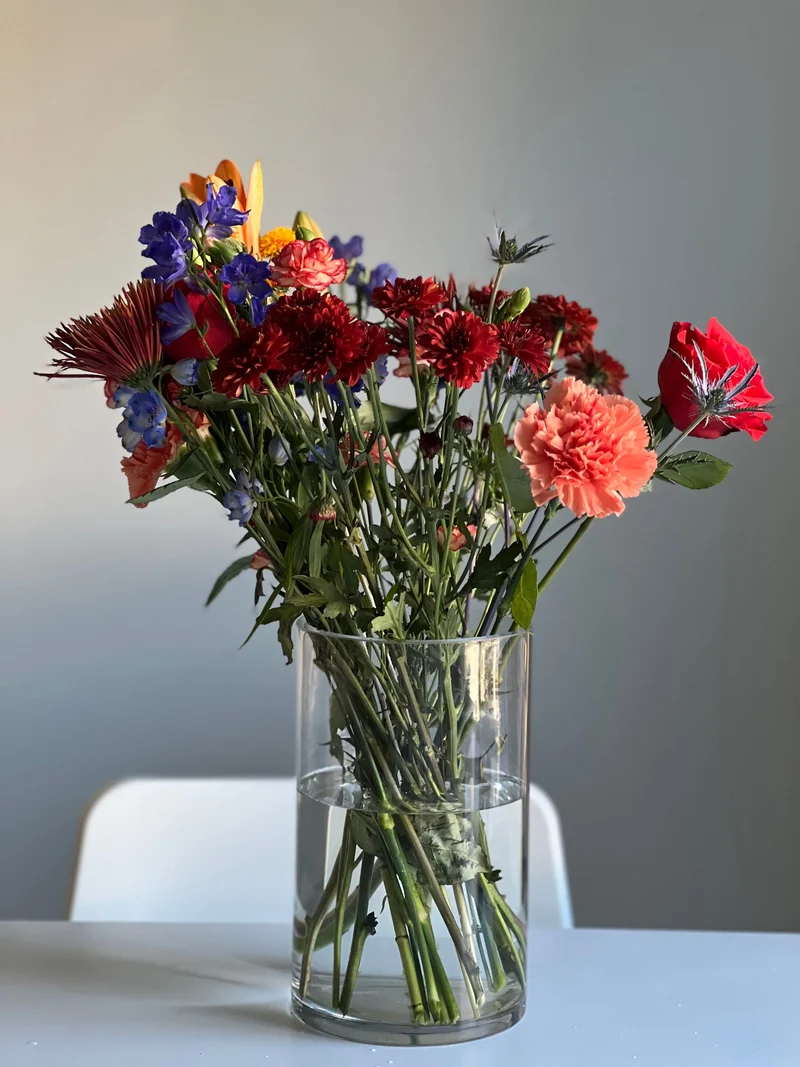 Phone photo
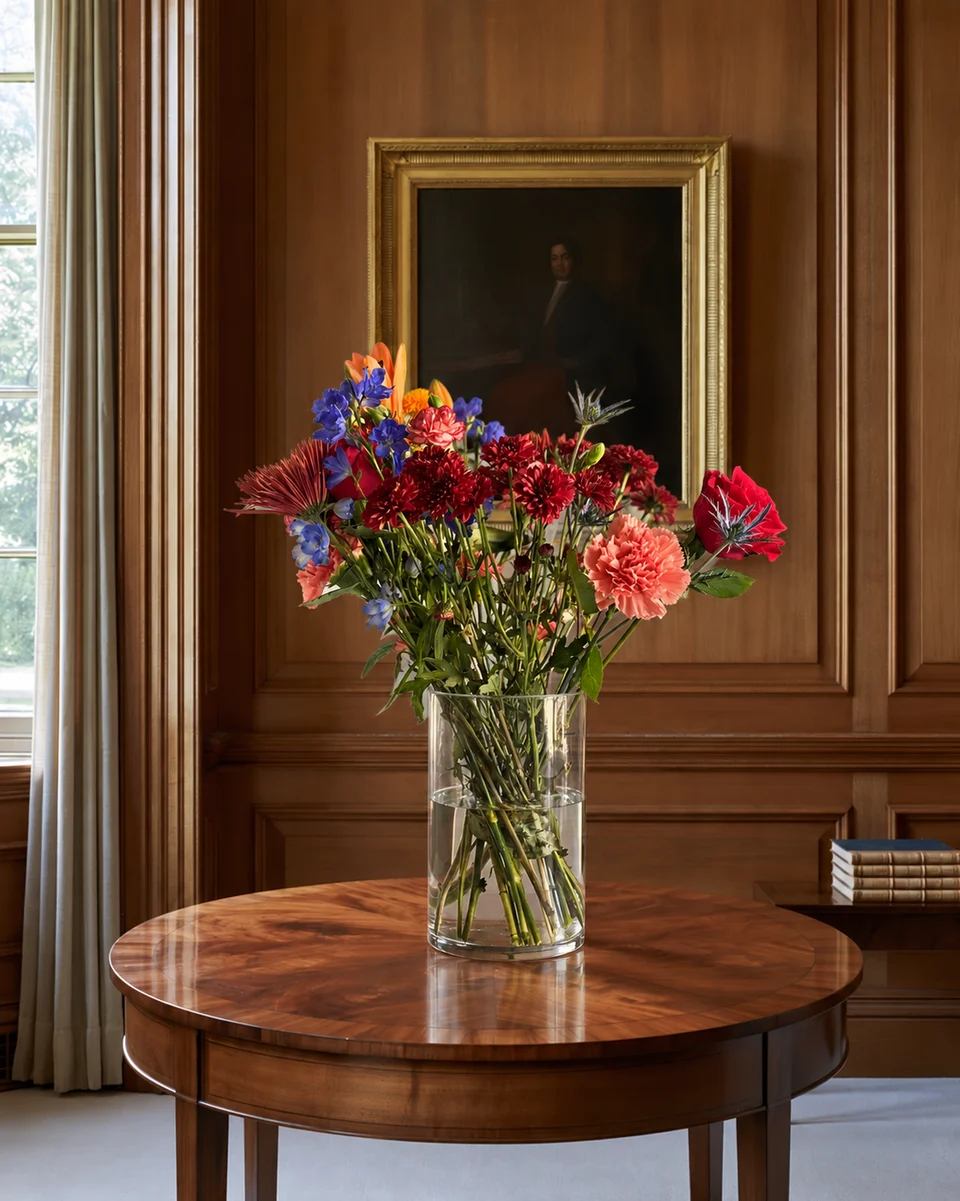 Studio photo
At a glance: what you need in the US
| Step | What to do | When |
|---|---|---|
| Business structure | Start as a sole proprietor, with no company needed. Form an LLC later, or from the start, to keep business and personal risks apart. | Day one |
| Business name (DBA) | Register it with your state or county if you don’t trade under your own name. | Before you use the name |
| EIN | Free from the IRS online. Needed for employees, partnerships and corporations, and handy for every florist. | Before you open wholesale accounts |
| Seller’s permit | Register with your state’s tax department in the 45 states (and DC) with a sales tax. | Before your first sale |
| Resale certificate | Give it to wholesalers so you don’t pay sales tax on flowers you resell. | When you open a wholesale account |
| Local business license | Ask your city or county, and check home-business zoning. | Before you start |
| Federal tax | Profit on Schedule C, 15.3% self-employment tax on most of it, and quarterly estimated tax if you’ll owe $1,000 or more. | Every year, and each quarter |
| Florist license | Not required, except a floral dealer permit in Louisiana. | Louisiana only |
| Certification | Optional: AIFD’s CFD, state association programs or college courses. | Whenever you like |
Step 1: Decide what kind of florist you’ll be
Your niche decides your suppliers, your prices, your hours and your marketing. Most new florists start with one or two of these and add more later.
| Model | Good for | Watch out for |
|---|---|---|
| Home studio with local delivery | Low start-up costs, everyday and gift orders | Home-business rules, cold storage, holiday rushes |
| Weddings and events | Higher order values, creative work | Deposits, contracts, weekend work, months between bookings |
| Subscriptions for homes and offices | Steady weekly income and easy planning | Reliable delivery every week |
| Farmers’ markets and pop-ups | Meeting customers and testing designs | Market fees, weather, a permit for the stall |
| Dried and preserved flowers online | Shipping nationwide, Etsy | Packaging, shipping costs, competition |
| Retail shop | Walk-ins, a visible local brand | Rent, a lease and staff before the first sale |
Step 2: Choose a business structure
- Sole proprietor: the default when you start selling on your own. Nothing to file to form it, and your profit goes on Schedule C of your personal tax return. You are personally responsible for the business’s debts.
- Single-member LLC: filed with your state, usually through the Secretary of State, for a fee that varies by state. It helps keep business debts and claims apart from your personal assets, as long as you keep separate business accounts. By default the IRS taxes it like a sole proprietorship, so your tax return barely changes.
- Partnership or multi-member LLC: for two or more owners. Write down who does what and who owns what before you start.
- S corporation election: some profitable florists elect it later to reduce self-employment tax. Ask an accountant once your profit is steady; it adds payroll and paperwork.
If you trade under a name that isn’t your own legal name, register it as a DBA (“doing business as”) with your state or county. Check that the name is free as a web address and an Instagram handle first; the free flower shop name generator can help you brainstorm.
Step 3: Licenses, permits and registrations
EIN (Employer Identification Number)
Free from the IRS online, in minutes. You need one for an LLC with employees, a partnership or a corporation; a sole proprietor can use their Social Security number, but an EIN keeps it off W-9s and wholesale forms.
Seller’s permit (sales tax)
45 states and Washington, DC have a statewide sales tax, and fresh flowers and arrangements are generally taxable. Register with your state’s tax department before your first sale, then collect and file sales tax on its schedule.
Resale certificate
With a seller’s permit, you give wholesalers a resale certificate so you don’t pay sales tax on flowers you will resell. Many wholesalers ask for one before they sell to you at wholesale prices.
City or county business license
Many cities and counties require a general business license, and zoning rules decide whether customers can collect from your home. Ask your city hall or county clerk.
Louisiana only: floral dealer permit
Louisiana was the only state with a florist exam and license. A 2024 law (Act 643) replaced them with a floral dealer permit from the state Department of Agriculture and Forestry.
Selling live plants?
If you also sell potted plants, some states require a nursery or plant dealer license from the state agriculture department. Check before you add them to your menu.
Market stalls and events
Farmers’ markets and pop-ups usually need the market’s approval and sometimes a temporary vendor permit. Some states also need a temporary sales tax registration.
Step 4: Taxes every new florist should know
- Form 1099-K: payment apps and marketplaces such as Square, Stripe and Etsy may report your sales to the IRS on a 1099-K. All business income is taxable whether or not you get one.
- Self-employment tax: 15.3% (12.4% Social Security and 2.9% Medicare) on 92.35% of your net earnings, on top of income tax. You file Schedule SE once your net earnings reach $400.
- Quarterly estimated taxes: if you expect to owe $1,000 or more for the year, pay estimated tax four times a year (mid-April, mid-June, mid-September and mid-January) with Form 1040-ES. A common rule of thumb is to move 25–30% of every payment into a separate tax account, so the bill is never a surprise.
- Keep every receipt: flowers, vases, wrap, ribbon, tools, a cooler, delivery mileage, your website and apps like FlowerShoot are usually business expenses that lower your taxable profit.
- Home office: if part of your home is used regularly and only for the business, you may be able to deduct it. The IRS simplified method is $5 per square foot, up to 300 square feet.
- State and local taxes: most states also tax business income, and some cities do too.
- Hiring help for Valentine’s Day or Mother’s Day? Employees mean payroll taxes and, in most states, workers’ compensation insurance. Treating someone as a contractor when they work like an employee is a common and costly mistake.
Rules and numbers change, and every situation is different. This is general information, not tax or legal advice: a local accountant who works with small businesses is worth an hour of your time before your first busy season.
Step 5: Do you need a florist certification?
No US state requires a florist certification to sell flowers. Certifications are optional, but they build skills and give couples and corporate clients a reason to trust you, especially for weddings and events.
| Certification | From | How you earn it |
|---|---|---|
| CFD (Certified Floral Designer) | American Institute of Floral Designers (AIFD) | Complete an AIFD Education Partner program and pass AIFD’s online test, or pass the Professional Floral Design Evaluation (an online test plus a hands-on design evaluation). Continuing education keeps it current. |
| AIFD (Accredited Member) | American Institute of Floral Designers | AIFD’s top designation, earned at the same evaluation with a higher score. |
| TMF (Texas Master Florist) | Texas State Florists’ Association | An application and hands-on qualifying test, online classes and in-person sessions, then a final exam. TSFA membership is required. |
| State association programs | Your state florists’ association | Courses and certificates in design, care and handling, and business. Many also run wedding and holiday workshops. |
| Floral design certificates | Community colleges and floral design schools | Short courses, from weekends to a semester. Useful if you’re new to design. |
Step 6: Insurance
- General liability: covers injuries and damage at events, venues and markets. Many wedding venues ask for a certificate of insurance before you can set up.
- Commercial auto: a personal auto policy may not cover deliveries. Tell your insurer you use the car for business.
- Property and stock: a home policy often excludes business equipment, coolers and stock.
- Workers’ compensation: required in most states once you have employees.
Step 7: Buy flowers at wholesale prices
Local wholesalers
Most cities have a flower wholesaler. Bring your seller’s permit and resale certificate to open an account, and ask about their buying days and minimums.
Flower markets
Big cities have wholesale flower markets that open very early. Go once with a list and a budget before you buy in bulk.
Online wholesalers
Box deliveries to your door, often with minimum orders. Useful outside big cities, but plan for a day of conditioning after delivery.
Local growers
Seasonal, scented stems that travel less and make your work look different from supermarket bouquets. Search for growers near you through local farm and cut-flower directories.
Step 8: Price so the business pays you
New florists most often under-price, then work the busiest week of the year for almost nothing. A simple way many florists price: the cost of flowers and greenery times about 3, plus the vase or wrap times about 2, plus labor (often another 20–30% on top of that), then delivery. Weddings and events usually carry higher markups for the planning and on-site work. Add waste too: if one stem in ten goes in the compost, the stems you sell have to pay for it. Card fees of around 3% also come out of every sale.
The free flower pricing calculator does these sums for any design, including waste, and works out Standard, Deluxe and Premium prices you can put straight onto a florist menu.
Step 9: Photos are one of the most important parts of your business
Before anyone smells your roses, they see a photo. Customers order flowers online, on Instagram and on Google Maps by picture alone, and they judge your price by how the photo looks. A beautiful arrangement photographed on a kitchen counter, in yellow evening light, with the fridge in the background, looks cheaper than it is. For most orders you’ll ever take online, the photo is what makes the sale.
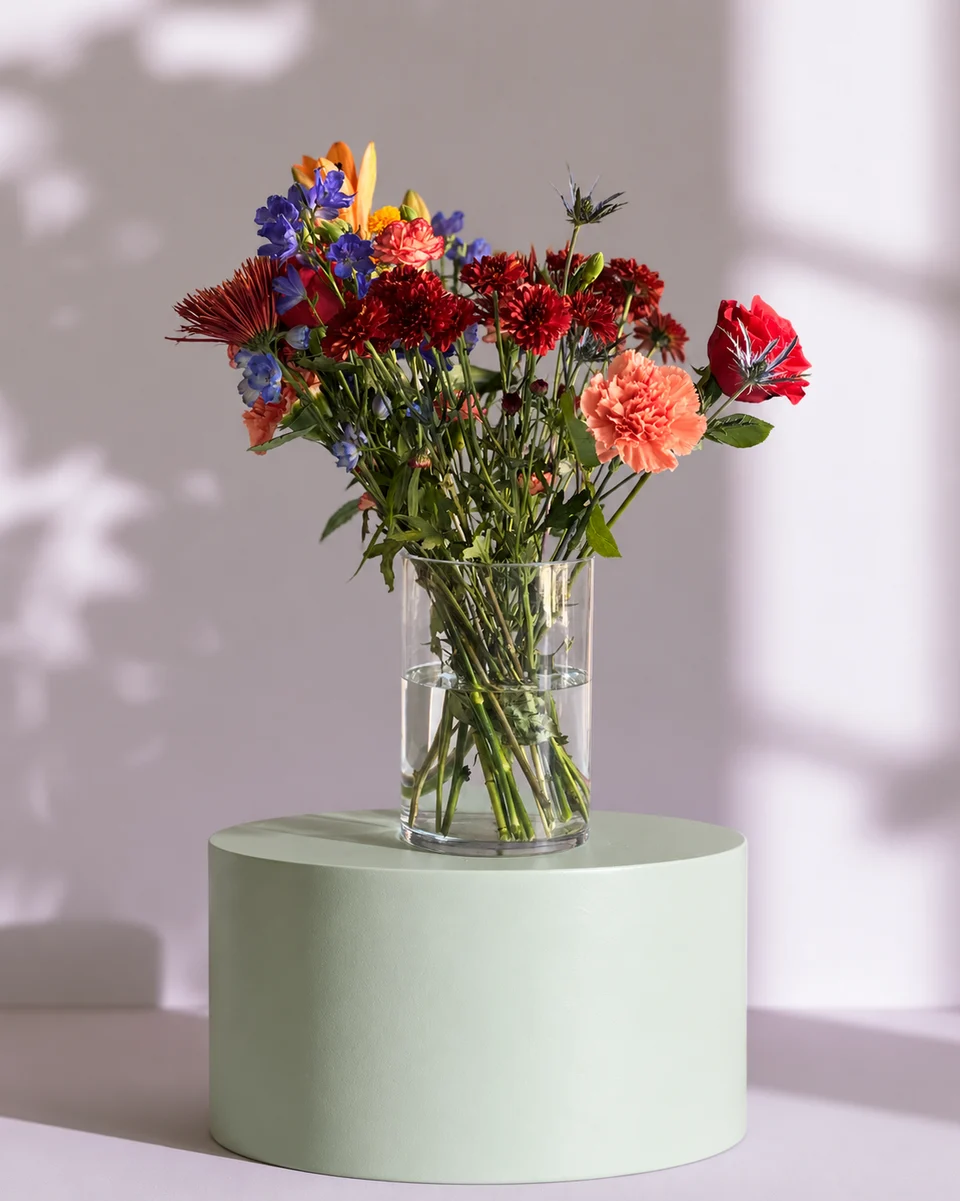
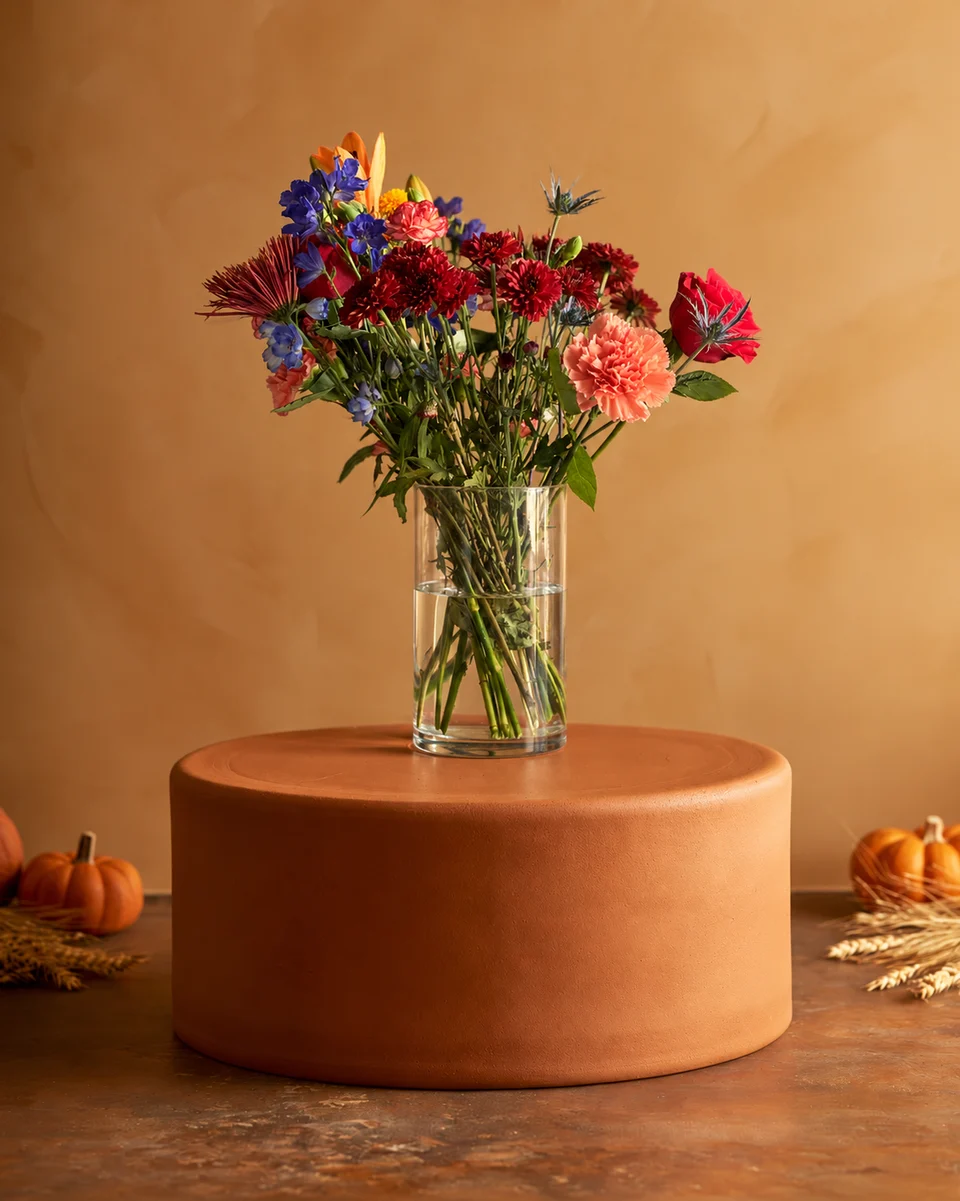
The trouble is that a phone photo rarely looks like a professional product photo, however good the flowers, and a photographer for every new design isn’t realistic when you’re starting out. That is why we built FlowerShoot: take one phone photo of your arrangement, choose a room made for flowers, and in about a minute you have a studio product photo that looks like an ad, with your real flowers and vase. No lights, backdrops, editing or reshoots, so the hours you’d spend setting up go back into designing and selling.
Phone photo Studio photo
 Studio photo
 Studio photo
Stand out on a small budget
You don’t need a photographer, a studio or a designer to look like an established shop. FlowerShoot is a low-cost tool made for florists that does three jobs every new flower business needs:
- Studio product photos: one phone photo of your arrangement becomes a studio photo in about a minute, in 200+ rooms made for flowers, with your real flowers and vase. Use one room for your whole menu and your shop looks consistent everywhere.
- Photos for your website and listings: sizes for your website, Etsy, Google and social media, cropped around your flowers so a stem is never cut off.
- Ready-made templates: product cards with your name and price, florist menus, and a Campaign kit with an Instagram post, Stories, a Pinterest pin and a banner for each occasion, plus captions and Etsy listing words, all with your logo.
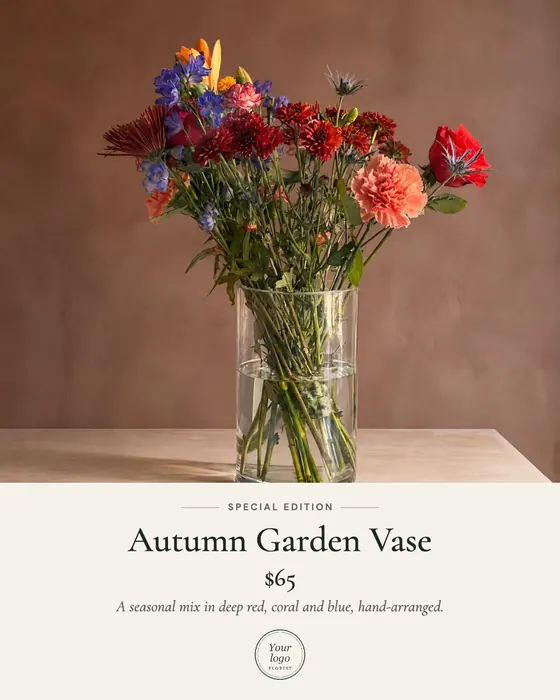 Product card
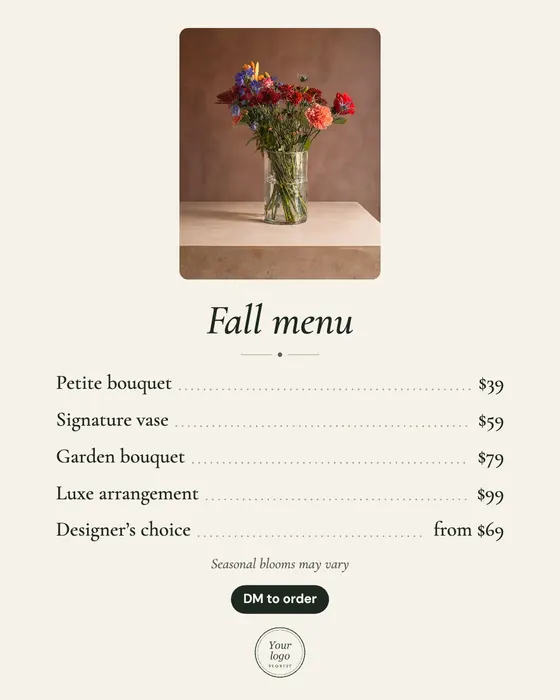 Menu
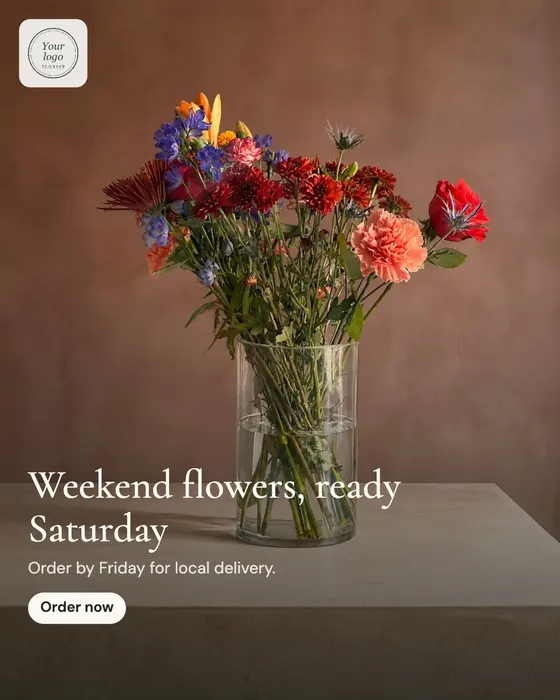 Order-by post
Step 10: Set up where people order
- A Google Business Profile: free, and often the first thing local customers see. A home florist can hide the address and show a delivery area. Read Google Business Profile for florists.
- A simple website: with delivery dates, card messages at checkout and your best photos. See flower shop website photos.
- Instagram and Facebook: where people discover local florists. One good photo becomes a week of posts.
- A card reader and online payments: so no order is lost at a market or a pick-up.
Wire services and fake local florist websites
Wire services such as FTD, Teleflora and BloomNet can send you orders from other florists and websites, for fees and a share of each order. Read the contract carefully: fees, minimum monthly charges and the recipes you must match. Separately, some national websites (known as order gatherers) look like local shops in search results, take the order and a cut, and pass a smaller order to a real florist. The best defence is to be easy to find and order from directly: a claimed Google profile, your own website and photos people recognise as yours.
The US florist year
| When | Occasion | Plan ahead |
|---|---|---|
| February 14 | Valentine’s Day | Order roses early; wholesale prices rise in the weeks before |
| March or April | Easter | Lilies, spring centrepieces and church flowers |
| Late April | Administrative Professionals Day | Office deliveries; a good time to sell weekly office flowers |
| Spring | Prom | Corsages and boutonnieres, often ordered by text with a photo of the outfit |
| Second Sunday in May | Mother’s Day | Open pre-orders weeks ahead with a small fixed menu |
| May to October | Wedding season | Consultations and deposits months ahead |
| September and October | Homecoming and fall | Mums and corsages in some regions, fall colours everywhere |
| Late November | Thanksgiving | Table centrepieces |
| All year | Sympathy | Funeral homes order year-round; introduce yourself to the ones nearby |
| December | Christmas and holidays | Wreaths, centrepieces and corporate orders |
Get your holiday photos ready before the rush with Valentine’s menu photos and Mother’s Day menu photos.
Your first 30 days
Week 1: paperwork
Choose your structure and name, get an EIN, register for a seller’s permit and check your city or county license.
Week 2: suppliers and designs
Open a wholesale account, buy a small first batch, design three to five signature pieces and price them.
Week 3: photos and ordering
Make your studio photos with FlowerShoot, build your menu and set up your Google Business Profile, website and payments.
Week 4: launch
Tell people you know, deliver your first orders, add a card with your name to every one and ask happy customers for a Google review.
More help: how to start a flower business from home, how to start a flower business in Canada, the best apps for florists and florist marketing ideas ranked by cost.
Made only for florists
From a bench photo to your next listing
Your flowers are the product. FlowerShoot makes the photo as lovely as the arrangement, wherever you share it: one phone photo in, a studio photo out.
For social media
Fresh posts and Stories every week, without a photo shoot or moving a single bucket. Download post and Story sizes with your logo and a caption, and let your flowers shine in a calm, professional feed.
For selling on your website
Choose a house style for your collection, then check each result against the piece you sell. Keep a real product photo alongside staged views, with clear size and vessel details.
- Skip the photographer. A studio photo from one phone photo, in about a minute.
- Standard photos from 19.5¢. One standard photo uses 1 credit. Monthly plans start at $10 for 50 credits. Optional 4K generation uses 2 credits.
- Try before you subscribe. Start with 3 free previews, no card. Monthly plans start at $10 for 50 credits.
- Your real flowers. Start from your own arrangement. Compare the result with the original before listing it.
- 200+ rooms made for flowers. Studios, pedestals, homes, weddings and every season.
Quick answers
Do you need a license to be a florist in the US?
No state requires a florist license except Louisiana, which since 2024 asks for a floral dealer permit instead of its old exam. You still usually need a seller’s permit for sales tax and may need a city or county business license.
Should a florist be an LLC or a sole proprietor?
Many start as sole proprietors because it’s simplest, then form an LLC to separate business risks from personal assets, especially before weddings and events. An LLC is taxed like a sole proprietorship by default. Ask an accountant or attorney for your state.
How do florists buy flowers at wholesale prices?
Register for a seller’s permit in your state, then open an account with a flower wholesaler and give them a resale certificate, so you don’t pay sales tax on flowers you resell.
What taxes does a florist pay?
Sales tax collected from customers in most states, income tax on profit, and 15.3% self-employment tax on most of your net earnings. If you expect to owe $1,000 or more, pay quarterly estimated tax.
Do I need a certification to open a flower shop?
No. Certifications such as AIFD’s Certified Floral Designer (CFD) or the Texas Master Florist are optional. They build skills and credibility, especially for weddings.
How much does it cost to start a florist business?
It depends most on whether you rent a shop. A home studio can start with buckets, tools, a cool space, a first batch of flowers, a seller’s permit and simple online ordering, and grow from there. A retail shop adds rent, a cooler, fittings and staff.
What is the best way to get product photos for a new flower shop?
Take one phone photo of each design in soft window light and turn it into a studio product photo with FlowerShoot, in about a minute, in a room made for flowers. You can try 3 free previews without a card.
Sources
- IRS: self-employment tax
- IRS: Publication 334, Tax Guide for Small Business
- IRS: get an Employer Identification Number
- SBA: launch your business
- AIFD: becoming a Certified Floral Designer
- TSFA: becoming a Texas Master Florist
- Pelican Institute: Louisiana florist licensing case
Platform rules change. Check each one’s current help pages before you upload.
Prices on this page are in US dollars.